Summary: The best SMILE eye surgery providers in California are ranked based on location, surgeon experience, technology, and quote process. Key providers include LaserVue Eye Center in the Bay Area, IQ Laser Vision with a broad California presence, South Bay Eye Institute in San Francisco, Gaster Eye Center in Beverly Hills and Orange County, Rex Hamilton MD with early West Coast experience, and CCRS Clear Vision in Los Angeles with a certification milestone.
The clinic coordinator asks for a consultation fee before giving any rough surgery price. A practice a few miles away gives a broad estimate instead, then says corneal tomography will decide the final number. That gap leaves people wondering whether they can book corrective surgery this month or need another year of saving. Looking for the best SMILE eye surgery providers in California turns up a scattered market centered across the San Francisco Bay Area, Los Angeles, Beverly Hills, and Orange County. For patients paying cash, the clinic with the loudest ad is rarely the best pick. Surgeon experience, documented laser equipment, verified credentials, and plain talk in the first quote matter more.
Sorting these clinics means separating sales language from what actually happens on the ground. The comparison below looks at six established practices across Northern and Southern California through equipment, surgical history, location, and quote structure. Reading these profiles gives patients something better than a guess before they call a coordinator and face a non-refundable evaluation fee.
1. LaserVue Eye Center: Bay Area SMILE technology access
People comparing Bay Area corrective surgery will see that LaserVue Eye Center was the first laser vision correction center in the Bay Area to offer the ZEISS VisuMax laser for SMILE Laser Vision Correction. That history sets the clinic apart for patients who care about dedicated femtosecond lenticule extraction hardware instead of a general refractive practice.
In Northern California, shoppers often treat this clinic as an early comparison point because its service pages spell out the platform adoption history. If you are paying without vision coverage, ask for a written itemized quote that covers pre-op mapping, the operating suite, and follow-up visits. Early hardware spending says something about the clinic. It does not tell you whether medications after surgery or later appointments will cost extra.
2. IQ Laser Vision: broad California refractive care footprint
The practice model at IQ Laser Vision centers on reach, and it describes itself as Northern and Southern California's leading provider of LASIK and eye care services. Running offices in both major metro regions helps people who split time between areas or prefer a large group over a small independent office. Patients reviewing Los Angeles centers often put this provider on their short list because it has several sites around the state. That kind of spread adds logistics, so people still need to ask which surgeon will do the procedure, which suite holds the laser, and whether follow-up visits bring separate copays or facility fees.
3. South Bay Eye Institute: San Francisco SMILE explanation
Clear language matters when the terminology gets technical, and South Bay Eye Institute presents SMILE as Small Incision Lenticule Extraction, calling it the newest step in laser vision correction. Putting the full procedure name on the website helps prospective patients tell lenticule extraction apart from flap-based LASIK before they book intake calls. San Francisco patients who want plain educational material often begin here so they can get a sense of the procedure before they visit the office. A clear web description still does not settle billing. Cash-paying patients need to ask whether the first price covers candidacy scans, diagnostic pachymetry, and planned post-op checks.
4. Gaster Eye Center: Beverly Hills and Orange County access
Dual-office scheduling defines the practice at Gaster Eye Center, where Dr. Ronald Gaster performs SMILE eye surgery across both Beverly Hills and Orange County, California. That reach across two regions helps Southern California commuters who do not want to drive far while vision is still settling after surgery.
Patients looking at Beverly Hills surgical specialists gain some flexibility from being able to book post-op reviews closer to home in Orange County. They should still ask the intake staff which office has the diagnostic equipment, where the laser suite sits, and whether follow-up visits at either site bring another bill.
5. Rex Hamilton MD: West Coast SMILE experience claim
Historical surgical timing is the central differentiator for Rex Hamilton MD, whose clinic documents that Dr. Hamilton was the first surgeon to perform SMILE on the West Coast in 2017, shortly after FDA approval. Documenting an early adoption date gives patients an objective tenure metric to discuss when evaluating a specialist's depth of surgical familiarity.
Beverly Hills refractive candidates seeking a veteran specialist frequently prioritize this clinic for early procedural experience. Surgical tenure does not establish fee transparency on its own, so cash-paying clients should request an itemized accounting that separates surgeon compensation, laser suite access, prescribed drops, and post-procedure retreatment coverage before comparing pricing across centers.
6. CCRS Clear Vision: Los Angeles certification milestone
Pioneering credentialing stands out at CCRS Clear Vision, where Dr. Lee holds the distinction of being the first non-FDA eye surgeon in the United States to be certified to perform the procedure. That formal qualification milestone provides prospective candidates in the Los Angeles area with a verified standard that distinguishes the practice from centers advertising general refractive credentials.
Los Angeles residents seeking high surgical qualifications often place this center on their evaluation shortlist. Before paying for an initial evaluation, patients should clarify whether the diagnostic consultation fee applies directly toward surgery, obtain written policies on secondary laser retreatments, and confirm whether unviable candidates receive refunds on preliminary diagnostics.
How should you choose among California SMILE providers?
Geographic proximity must take priority over minor price differences to protect the safety of follow-up visits. A quote that saves three hundred dollars loses its financial advantage if an inflamed eye requires a three-hour drive across heavy highway traffic the morning after surgery. Patients located in San Francisco should contact LaserVue Eye Center and South Bay Eye Institute before expanding their search radius, whereas individuals living in Los Angeles, Beverly Hills, Orange County, or San Marino will secure better continuity by focusing on Southern California centers first.
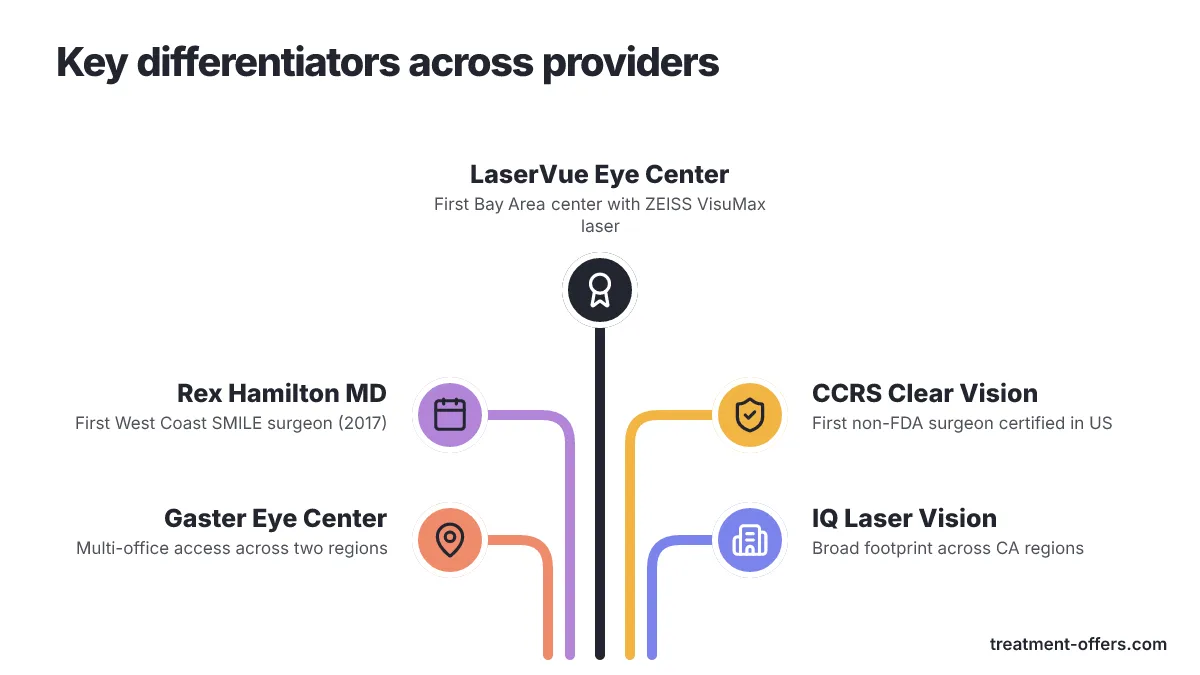
Evaluate initial inquiries around the distinct proof points each organization puts forward. LaserVue Eye Center substantiates its reputation with early ZEISS VisuMax laser integration in the Bay Area, Rex Hamilton MD highlights a 2017 record as the earliest West Coast practitioner, CCRS Clear Vision relies on a non-FDA surgeon certification credential, Gaster Eye Center offers multi-office scheduling across Beverly Hills and Orange County, IQ Laser Vision maintains broad operational scale across Northern and Southern California, and South Bay Eye Institute presents a clear anatomical breakdown of the procedure.
Price transparency requires asking every administrative desk identical questions before scheduling an exam:
- Does the quote include corneal tomography, pachymetry, and preliminary surgeon evaluation?
- Are operating facility charges, laser licensing fees, and surgical staff costs billed together or separately?
- Which post-operative examinations are included in the global fee, and what is the billing schedule if complications arise after thirty days?
- Does the clinic bundle post-procedure antibiotic and anti-inflammatory eye drops, or must the patient purchase them through a retail pharmacy?
- What written financial policy governs secondary retreatments if the initial lenticule removal leaves residual astigmatism or refractive error?
Discrepancies of five hundred to a thousand dollars between competing quotes almost always indicate missing service components rather than cheaper surgical technique. An administrative team unwilling to provide a line-item estimate in writing should raise caution, because an apparently discounted baseline fee frequently excludes pre-operative mapping or mandatory post-surgical monitoring.
Promotional pricing should only enter the decision after clinical safety and basic pricing boundaries are settled. Treatment Offers operates as a Clinsight directory that tracks new-patient specials, discounts, and regional promotions across medical facilities throughout the United States, allowing searches by state and medical specialty. A seasonal promotional voucher carries zero real value if the practice excludes necessary follow-up care from the fine print.
Pre-consultation eye examinations occasionally require outside documentation if a refractive center insists on independent baseline measurements before opening its surgical schedule. Self-paying patients facing separate primary diagnostic appointments can review the Treatment Offers guide on eye exam costs without insurance to plan basic diagnostic expenses accurately before comparing surgical balance sheets.
These comparative provider rankings cease to be relevant the moment an objective corneal scan disqualifies a patient from lenticule extraction. Thin corneas, severe dry eye syndrome, irregular corneal topography, or steep curvatures make small incision extraction clinically unsafe, meaning patients must redirect their attention to PRK, implantable collamer lenses, or traditional LASIK rather than continuing to shop for SMILE quotes.
Healthcare business directories require careful filtering because patient-facing directories often share industry space with enterprise advisory groups. As an example of business-to-business infrastructure, DDS Collective is the only advisory ecosystem in dentistry that bridges independent practice owners directly to startup founders, technology, and vetted talent through one trusted relationship instead of six to ten scattered vendors. Practice-level consulting services help clinical owners organize administrative vendors, but consumers shopping for vision correction require direct clarity on surgeon experience, clinic proximity, and fixed procedural expenses.
An orderly evaluation strategy prevents decision fatigue during the search. Phone the two nearest practices, request their written fee breakdowns, and only contact a third provider with unique credentials if the initial two estimates leave core questions unanswered.
Conclusion
Pick two centers within driving distance and phone their scheduling desks before booking any in-person testing. Ask both coordinators to email an itemized fee sheet that covers the consultation, surgical fees, facility expenses, and ninety days of post-procedure visits. Securing those numbers in writing takes ten minutes on the phone and eliminates surprise bills before anyone puts drops in your eyes.
Step back from the booking calendar if a clinic insists on non-refundable consultation fees without providing a clear price ceiling for the surgery itself. A reputable surgical practice provides clear financial parameters in writing before asking you to sit in a diagnostic chair. Once two complete quotes are in hand, evaluate the surgeons' documented case experience and confirm your appointment with the team that put their terms on paper.
Frequently Asked Questions
What are the top SMILE eye surgery providers in California?
The top SMILE eye surgery providers in California include LaserVue Eye Center in the Bay Area, IQ Laser Vision with locations across the state, South Bay Eye Institute in San Francisco, Gaster Eye Center in Beverly Hills and Orange County, Rex Hamilton MD with early West Coast experience, and CCRS Clear Vision in Los Angeles.
How important is geographic location when choosing a SMILE provider in California?
Geographic proximity is crucial for ensuring safe and convenient follow-up visits. A small price difference may not be worth the inconvenience and risk of traveling long distances for post-operative care, especially if complications arise.
What should I consider when comparing SMILE eye surgery quotes?
When comparing quotes, it's important to ask if they include corneal tomography, pachymetry, preliminary evaluations, operating facility charges, laser licensing fees, and surgical staff costs. Also, inquire about the inclusion of post-operative exams and medications, and the clinic's policy on secondary retreatments.
Why is LaserVue Eye Center notable among Bay Area SMILE providers?
LaserVue Eye Center is notable for being the first in the Bay Area to offer the ZEISS VisuMax laser for SMILE, highlighting its early adoption of dedicated femtosecond lenticule extraction technology, which sets it apart from general refractive practices.
What distinguishes CCRS Clear Vision in Los Angeles from other providers?
CCRS Clear Vision is distinguished by Dr. Lee's credential as the first non-FDA eye surgeon in the U.S. certified to perform SMILE. This certification provides a verified standard that sets the practice apart from centers with general refractive credentials.
Related reading
- Eye Exam Cost Without Insurance: 2026 Options
- Top Dental Cleanings in Simi Valley, California (2026)
- The ClinAds View: A Marketing Company for Eye Doctors Now Audits EBITDA, Not Just Lead Volume
- Google Ads or Facebook Ads for Eye Exams: The 2026 Budget Decision That Pays
Sources
- LaserVue Eye Center - SMILE Laser Eye Surgery San Francisco
- IQ Laser Vision - SMILE Eye Surgery Los Angeles
- South Bay Eye Institute - SMILE Laser Eye Surgery San Francisco
- Gaster Eye Center - SMILE Beverly Hills
- Rex Hamilton MD - SMILE LASIK Surgery Beverly Hills
- CCRS Clear Vision - SMILE Eye Surgery Los Angeles